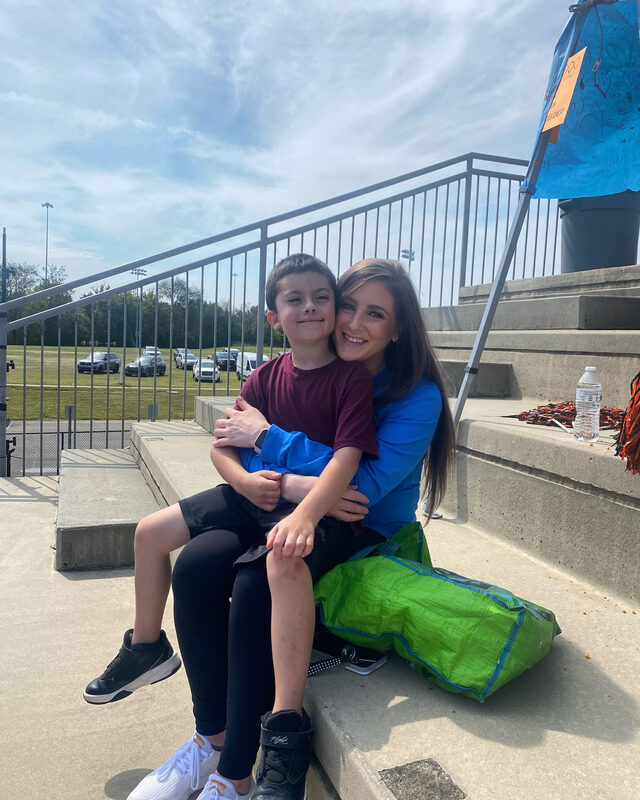
My name is Courtney. I'm a mom to Antonio — he's autistic, has sensory processing disorder, is a gestalt language processor. He's also the funniest person I know. He calls himself "Antonio the Grinch," his sister Haidyn "Cindy Lou Who," then dad, then me. Three years straight as the Grinch for Halloween. He carries his comfort stuffies everywhere — stuffed zombies, a Grinch, Pluto. He uses them to point to answers during lessons.
He's not a case number. He's not a placement decision. He's a kid who loves Plants vs. Zombies, the classroom swing, Itsy Bitsy Spider, recess. This is what happened when a system saw him — and what happened when one didn't.
Alabama — The School That Saw Him
We moved to Hoover, Alabama. Antonio started kindergarten. His teacher was Mista B.* She was supposed to be his teacher K through 2nd grade — made it through 1st before the next school pulled her because their special needs department was a mess. She was that good. Even after she moved up, she came back in first grade to do his IEPs, to make sure he was taken care of.
*That's what Antonio called her. It stuck.
Mista B didn't just teach Antonio. She learned him. When the school did a Grinch theme for the holidays, the whole building looked like Dr. Seuss' Whoville. Mista B took time out of her day to come back and personally walk him through it — in his Grinch slippers, carrying his comfort stuffies. Because Alabama put alternative footwear in his IEP. They didn't just allow it. They wrote it into the document. That wasn't a school requirement. That was a teacher who saw a kid.
But it wasn't just her. It started with the principal. The whole school culture was built around actually seeing these kids. During Special Olympics, they had all the gen ed kids lined up in the hallways cheering them on as they got on the bus. That's not a policy. That's a school that decided these kids matter.
Antonio was in a self-contained classroom with a 1:1 aide, a bus harness for safe transportation, an adult with him everywhere outside the special ed room. He spent time with gen ed kids where it made sense — recess, sometimes specials like gym or art. Real inclusion. Not the kind that dumps a kid in a classroom then calls it progress.
On field trips, he rode his normal special needs bus — the same one from every morning. They'd put gen ed kids from his class on his bus for the ride there. Brought his peers to him. Mista B would let us know ahead of time if a field trip was one he'd enjoy or if it would be too much. If we couldn't go, they sent a para — always his school mom. His favorite. She did "rocket swing" with him. She filmed Mista B walking him through the Grinch wonderland. She chose him.
He got daily home-school communication. Progress reports every four weeks. At the end of kindergarten, Mista B planned a weekend get-together for her class. Antonio got the Laughy Taffy award.
And when it came time to transfer him to Connecticut, they amended the IEP to make sure the new school would know exactly how he learns:
Mista B's team didn't just hand over a stack of forms. They wrote down who Antonio actually is — how he thinks, what makes him feel safe, what unlocks learning for him. They gave Connecticut a blueprint of our son.
Connecticut — What Happened Next
We moved to Windsor, Connecticut. Antonio started at his new school. They had his full IEP — goals, services, accommodations, transition notes, the amendment about his stuffies, his slippers. Every page.
Day one, they took his comfort stuffies away.
They put him in general education for three weeks. Alabama's IEP was right there — it said he needed a separate setting, a self-contained classroom, the whole plan. They didn't read it. Three weeks later, they finally held an IEP meeting. That's when they wrote this:
Alabama already told them that. It took Connecticut three weeks to figure out what was already on paper.
They didn't set up his specialized transportation — Alabama had the safety harness in place from day one. They ignored the alternative footwear — Alabama wrote "Grinch slippers" into the IEP; Connecticut wouldn't even let him wear Crocs.
In Alabama, Mista B sent home a weekly email — what the kids were learning, what activities they did for each subject. Every Friday, Mista B and Mrs. G* did a cooking lesson with the class. Parents would buy the ingredients, the kids made treats that tied to the week's lesson. In Connecticut, the daily log said the same thing every single day. Every teacher conference was the same line: he's ready for gen ed.
*His 1st grade teacher.
At one point, the teacher told me "sometimes you have to give into him because he is relentless." Then at the end of the year, the same teacher stated he had no behavior problems. You can't have it both ways. But they documented it both ways.
The last straw was transportation. We wanted to know if the third-party transportation service was going to be switching the adult and van on us. The special needs director said he spoke to the company — they said they couldn't guarantee consistency — and couldn't even communicate ahead of time if there would be a change. For a kid with a safety harness in his IEP. For a kid who is routine-oriented. They couldn't keep the same van, and they wouldn't tell us when it was different.
We pulled him out. We homeschool him now. Needless to say.
Same Kid. Same IEP.
Alabama
- Self-contained classroom, 1:1 aide
- Safety harness on bus — day one
- Stuffies welcomed as learning tools
- Grinch slippers in the IEP
- Daily home-school communication
- Gen ed kids on his bus for field trips
- Special Olympics hallway send-off
- Mista B came back for him
- Met him in his imaginative world
Connecticut
- General education for 3 weeks
- Transportation not set up
- Stuffies taken day one
- Wouldn't let him wear Crocs
- Communication "bare at best"
- Contradictory behavior reports
- Kept pushing gen ed readiness
- Ignored the transition IEP
- Had the blueprint. Didn't read it.
Why I Built This
Four states. Massachusetts, Georgia, Alabama, Connecticut. I've sat in meetings outnumbered. I've read documents that contradicted what was happening in the classroom. I've watched my son thrive in a system that saw him, then watched another system try to undo it.
The paperwork existed. Every accommodation, every service, every support Antonio needed — written down, signed, transferred. Connecticut had the blueprint. They had the amendment Mista B's team wrote specifically for the transition. They had everything. It wasn't enough.
I built this because no parent should need to be a lawyer to make a school follow an IEP. Because if I — someone who reads every page, who asks every question, who fights every fight — couldn't stop it from happening to my kid, what happens to the parents who don't know they can fight?
Despite everything, Antonio kept growing. Knows all his letters now. Writes his name. Adding within 20. His dad told the IEP team he's shown "tremendous growth." Still stubborn — his dad told them that too. I wouldn't change it. Stubbornness is how we got here.
We homeschool him now. We meet him where he is — in his imaginative world, with his stuffies, in his Grinch slippers. The way Alabama did. The way it should have been all along.
You Shouldn't Have to Fight This Hard
But if you do — you should have the tools. Know your rights. Detect changes. Hold the system accountable.
Know Your Rights See All ToolsBuilt by a mom who read every page. For the parents who shouldn't have to.
💜